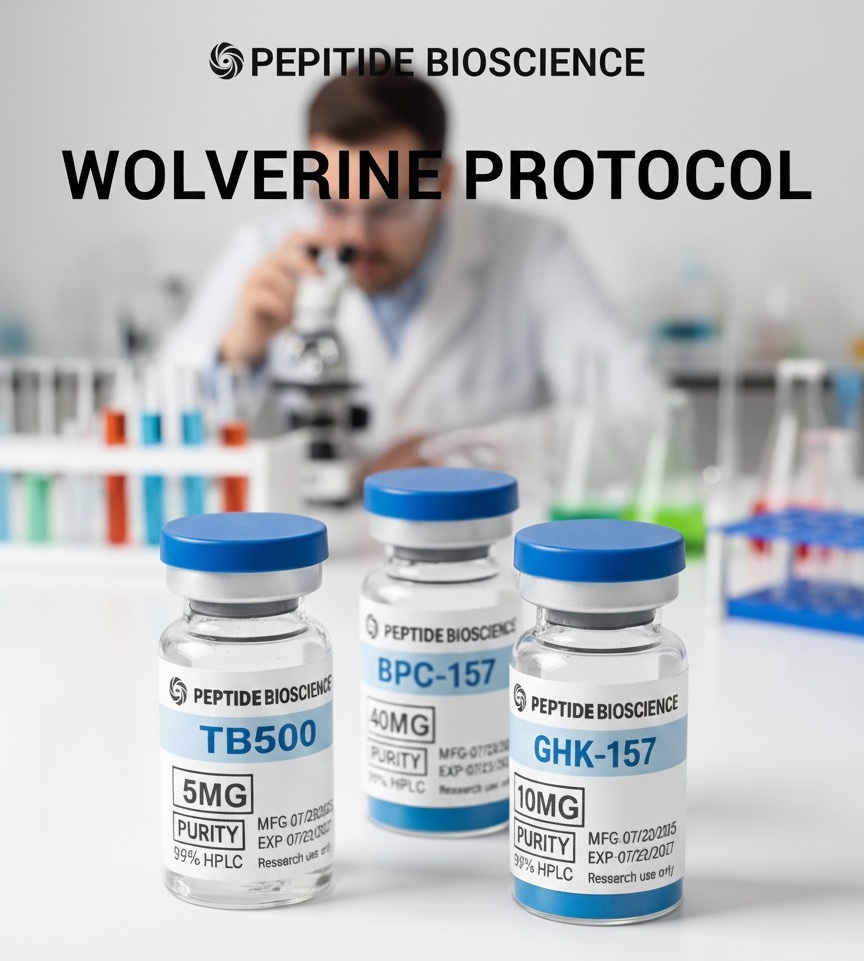
Peptide Information

Peptide Quality
How is Peptide Purity Achieved and Verified? At Peptide Bioscience, we specialize in providing peptides that consistently exceed 99% purity. By utilizing state-of-the-art solution and Solid-Phase Peptide Synthesis (SPPS) technologies, Peptide Bioscience offers the finest quality proteins and peptides tailored for rigorous research studies and advanced laboratory applications.
Our superior purity standards are achieved and verified through uncompromising manufacturing protocols and precision-driven production, ensuring stability and reliable results for every batch.
Peptide Purity
By Peptide Bioscience Team | January 8, 2026
ALL ARTICLES AND PRODUCT INFORMATION PROVIDED ON THIS WEBSITE ARE FOR INFORMATIONAL AND EDUCATIONAL PURPOSES ONLY. The products offered on this website are furnished for in-vitro studies only. In-vitro studies (Latin: in glass) are performed outside of the body. These products are not medicines or drugs and have not been approved by the FDA to prevent, treat or cure any medical condition, ailment or disease. Bodily introduction of any kind into humans or animals is strictly forbidden by law.
How is Peptide Purity Achieved and Verified?
At Peptide Bioscience, we provide peptides that exceed 99% purity. Using state-of-the-art solution and solid phase peptide synthetic technology, Peptide Bioscience is able to offer the finest quality peptides and proteins fit for any research study or application. Peptide purity is achieved and verified through uncompromising manufacturing and production processes, quality control measures, and the implementation of both high-performance liquid chromatography (HPLC) and mass spectrometry (MS) analysis.
HPLC and Mass Spectrometry
High performance liquid chromatography, or HPLC, is a scientific technique used to separate, identify, and quantify each component in a mixture. It is a superior process that allows highly accurate peptide testing to be accomplished. Mass spectrometry (MS) is a technique used to measure masses within a sample by ionizing chemical species and sorting the ions based on their mass-to-charge ratio.
The results are plotted with the ion signal as a function of the mass-to-charge ratio. Both methods are highly accurate peptide testing techniques and scientifically prove the purity and identity of peptides ordered from Peptide Bioscience.
Peptide Bioscience takes great pride in the quality of all of the products we manufacture, and we implement testing at all stages of peptide production at our synthesis lab, verifying our peptides’ sequential “fingerprints” for precision accuracy in every preparation.
What is the Recommended Peptide Purity Level?
Peptide Bioscience provides only the highest purity peptides (>99% pure) for sale for research and development use. However, preparations of peptides synthesized for research by many other manufacturers can vary widely in purity. Occasionally, researchers can wonder what the minimum acceptable level of peptide purity is for their given purpose.
Generally, the higher the peptide purity level, the more favorable the preparation; critically, for certain applications (such as in vitro studies or clinical trials), only exceedingly pure peptides will be appropriate (greater than 98% purity). However, there are some applications for which a lower peptide purity would be acceptable. The minimum recommended peptide purity level for a given application will therefore depend upon that specific application. Examples of minimum acceptable purity levels are as follows:
Highly Pure (>95% Peptide Purity)
-
In vitro and in vivo studies
-
Clinical trials
-
Drug studies in which peptides are used as pharmaceuticals
-
Cosmetic peptides for cosmeceuticals
-
Crystallography
-
Monoclonal antibody production
-
Quantitative protease studies and enzyme studies
-
Quantitative receptor – ligand interaction studies
-
Quantitative blocking and competitive inhibition studies
-
Quantitative ELISA and RIA protocol standard
-
Chromatography standard
Mid-range Peptide Purity (>85%)
-
Peptide blocking studies (Western blot)
-
Phosphorylation studies
-
NMR studies
-
Cell attachment studies
-
Semi-quantitative studies of enzyme-substrate interactions
-
Epitope mapping tests
-
Biological activity testing
Lower Peptide Purity (>70%)
-
Peptide arrays
-
Performing an ELISA standard for measuring titers of antibodies
-
Antigens for polyclonal antibody production or affinity purification
Those peptides with greater purity are appropriate for use in an application with a lower minimum acceptable level of purity. Peptide Bioscience provides exceedingly high purity peptides that will meet or exceed all previously stated purity requirements.
99% Purity